Cryptocurrency vs Fiat: 7 Key Differences for Traders (2026)
 Alexandra Winters
  Beatrice Quinn
In my guide to cryptocurrency vs fiat, I’ll walk through the seven core differences that actually affect your trading decisions — not just the textbook definitions you’ll find everywhere else.
Cryptocurrency is a digital asset secured by cryptography and running on a decentralized blockchain network. Fiat currency is government-issued money — USD, EUR, GBP — backed by central bank authority rather than a physical commodity. Both serve as a medium of exchange, but their mechanics couldn’t be more different.
According to the Chainalysis 2025 Global Adoption Index, approximately 861 million people worldwide now hold cryptocurrency, representing about 11% of the global population. That’s significant growth, but fiat still powers virtually every economy on earth. Traders who understand both sides have a genuine edge.
“Increasingly, I see advanced economies and emerging markets doubling down on measures to protect their domestic financial stability. This includes more of an emphasis on central bank digital currencies and adjustments to existing stablecoin regulations,” explains Josh Lipsky, Senior Director at the Atlantic Council’s GeoEconomics Center.
TL;DR: Cryptocurrency and fiat currency differ on seven fronts: control, volatility, supply, trading hours, liquidity, regulation, and transaction speed. With 861 million crypto holders globally (Chainalysis, 2025) and $7.5 trillion in daily forex volume (BIS, 2022), both asset classes matter for modern portfolio construction.
What Is the Difference Between Cryptocurrency and Fiat Currency?
The global crypto market cap hit $3.6 trillion in 2025 (CoinGecko, 2025), yet cryptocurrency and fiat currency operate on fundamentally different architectures. Understanding these structural differences is the first step toward allocating between them.
Fiat currency gets its value from government decree. A central bank — the Federal Reserve, the ECB, the Bank of England — issues it, controls its supply, and sets monetary policy. You can hold it physically as banknotes or digitally in a bank account. It’s legal tender, meaning merchants must accept it by law.
Cryptocurrency works differently. Bitcoin, the largest by market cap, runs on a decentralized blockchain — a distributed ledger verified by thousands of nodes worldwide. No single entity controls it. No one can print more. Bitcoin’s supply is capped at 21 million coins, hard-coded into its protocol.
That fixed-supply mechanic is the root of most differences between crypto and fiat. Central banks can expand fiat supply to manage inflation, stimulate growth, or respond to crises. Crypto protocols can’t. Some traders see that as a feature. Others call it a flaw. It’s really a trade-off — monetary flexibility versus supply certainty.
Where fiat transactions pass through banks and payment processors (intermediaries that verify, settle, and sometimes delay transfers), cryptocurrency transactions move peer-to-peer across the blockchain. No intermediary needed. That changes the speed, cost, and privacy dynamics significantly.
Browse our full library of crypto guides for deeper coverage of individual topics.

How Volatile Is Cryptocurrency Compared to Fiat?
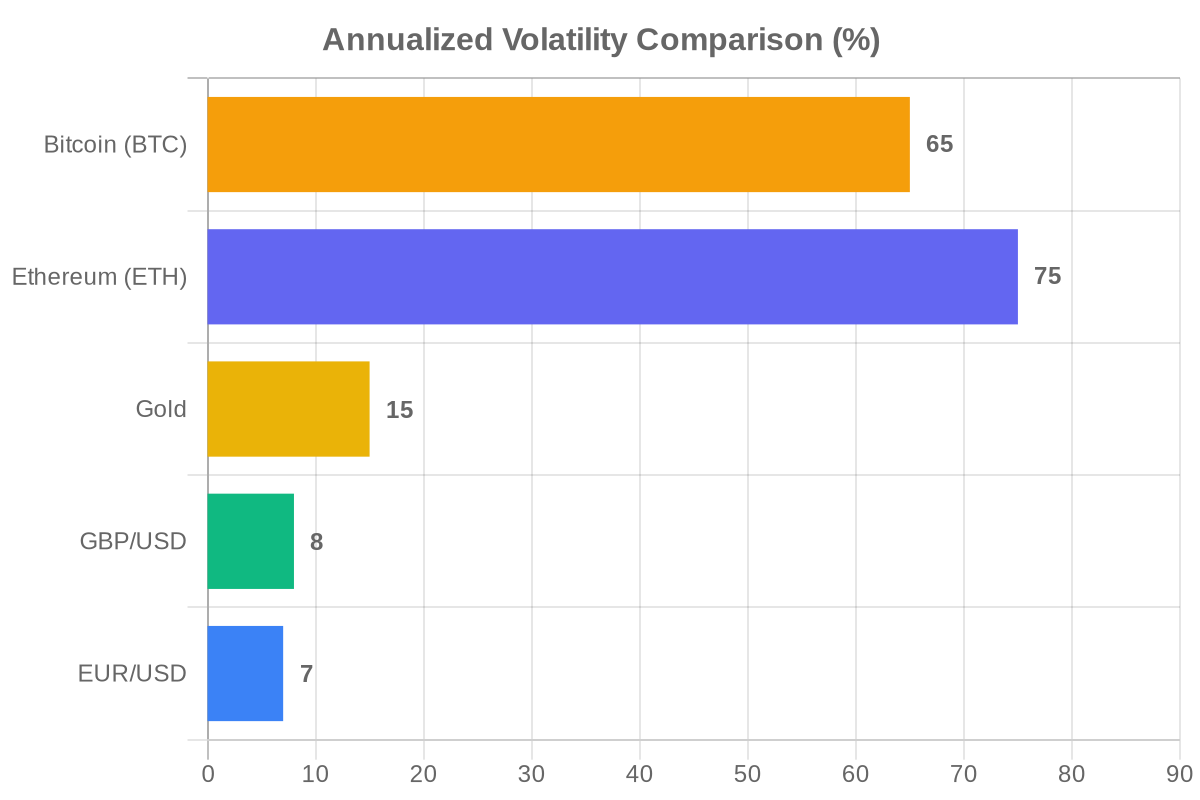
Bitcoin’s annualized volatility has historically ranged between 50-80%, while major fiat pairs like EUR/USD typically sit around 5-10% (BIS Markets Committee, 2021). That’s not a marginal gap — it’s an order of magnitude difference that shapes everything from position sizing to risk management.
Here’s what that looks like in practice. In late 2024, Bitcoin climbed from roughly $70,000 to over $100,000 in a matter of weeks. A 40%+ move. EUR/USD moving 2% in a month would make the front page of the Financial Times.
Crypto’s volatility has been slowly compressing as institutional participation grows and trading volumes deepen. But “slowly compressing” from 70% annualized still leaves you with volatility that most fiat traders would consider extreme. The asset class is maturing, not yet mature.
Why does this matter for traders? Crypto’s wide swings create opportunity — momentum trades, mean-reversion setups, and arbitrage windows that don’t exist in tightly quoted fiat pairs. They also create risk. A 10% overnight drop in Bitcoin can wipe out a leveraged position in minutes.
I’ve seen traders shift a small allocation — 5% of their portfolio — into BTC as a volatility kicker. When fiat pairs are range-bound (which, frankly, is most of the time), that crypto allocation generates activity. The key: they size it knowing a 20% drawdown is normal, not exceptional.
For a deeper comparison of profit potential, see our analysis of forex vs crypto profitability. And for context on downside scenarios, read about what causes crypto crashes.
How Do Crypto and Fiat Differ on Liquidity and Trading Hours?
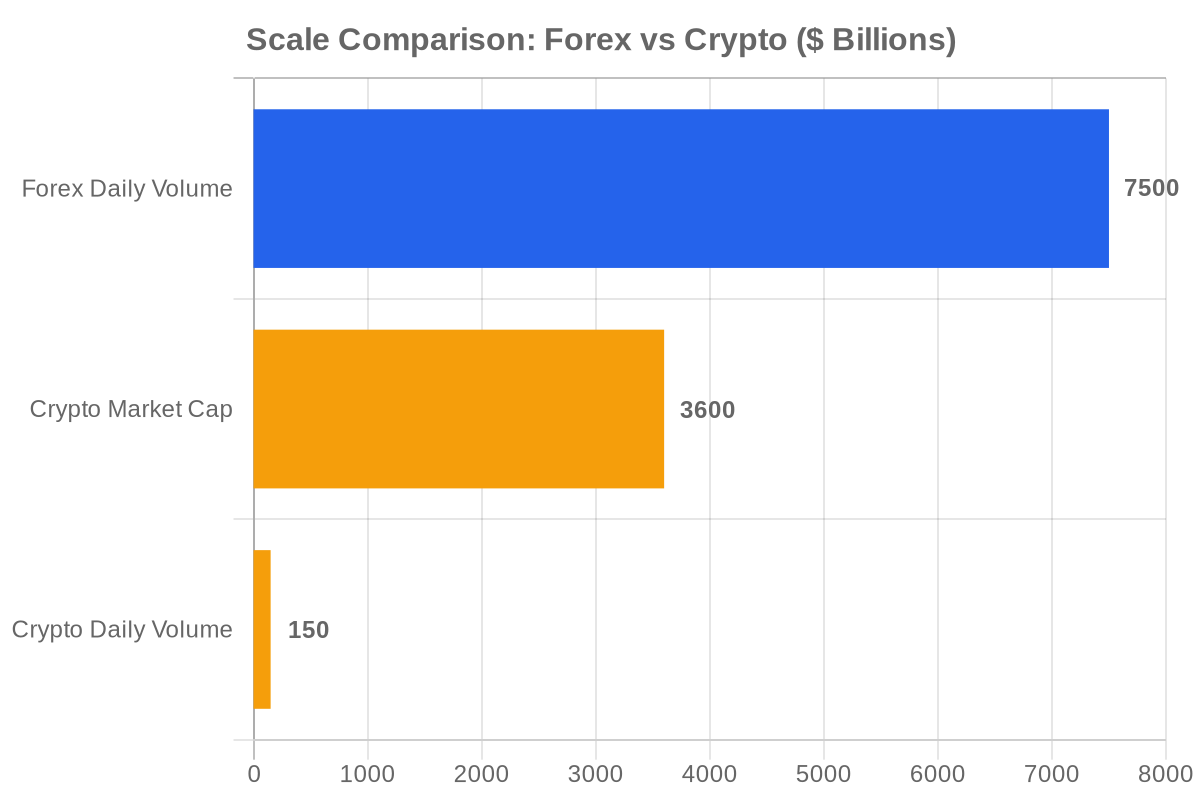
The forex market turns over $7.5 trillion daily (BIS Triennial Survey, 2022), making it the most liquid financial market on the planet. The entire crypto market cap — roughly $3.6 trillion — is less than half of one day’s forex volume. That liquidity gap matters for traders.
Crypto markets never close. Trading runs 24/7, 365 days a year. No weekend gaps. No holiday shutdowns. When news breaks at 3 AM on a Sunday, crypto prices react immediately. Forex operates 24/5 — Monday morning in Sydney through Friday afternoon in New York — with weekend gaps that can catch leveraged traders off guard.
The always-on nature of crypto sounds like an advantage, and sometimes it is. Arbitrage between BTC-KRW and BTC-USD becomes possible when Asian and American sessions overlap. But 24/7 also means 24/7 risk. There’s no “market closed” period to catch your breath.
Liquidity in crypto concentrates heavily. BTC-USD and ETH-USD pairs trade with tight spreads on major exchanges. Move into mid-cap altcoins and spreads widen fast — sometimes dramatically. A $50,000 market order in a small-cap token can move the price 3-5%. Try that in EUR/USD and the market wouldn’t notice.
For more on optimal timing, check our guide to cryptocurrency trading hours.
How Are Cryptocurrency and Fiat Currency Regulated?
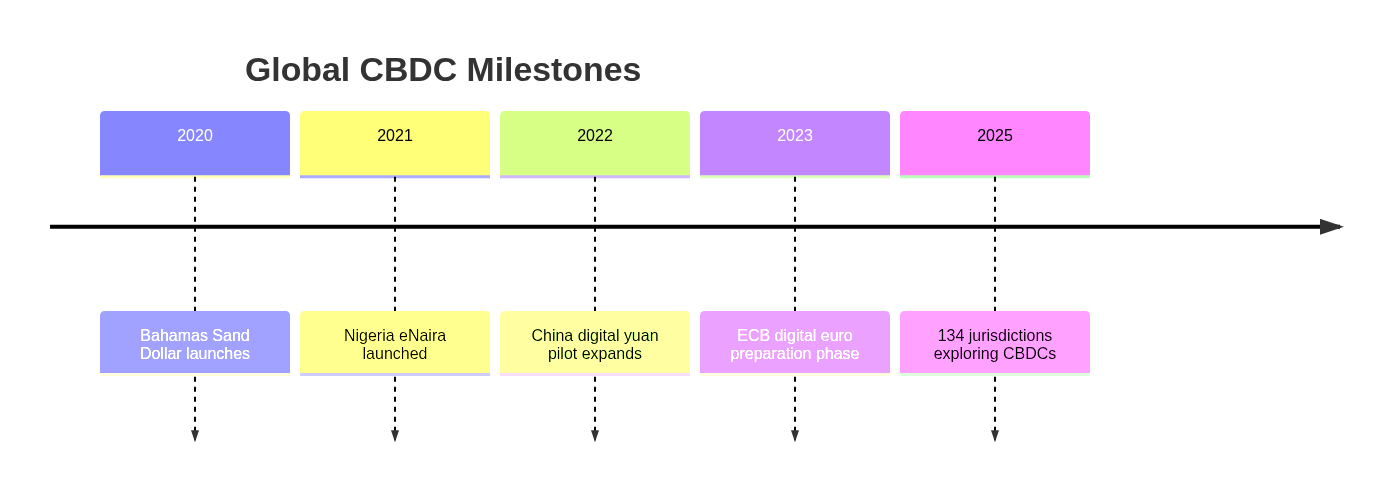
According to the Atlantic Council’s CBDC Tracker, 134 jurisdictions worldwide are now researching, piloting, or launching central bank digital currencies — a signal that governments see digital money as inevitable, but want it on their terms. Crypto regulation is catching up, not caught up.
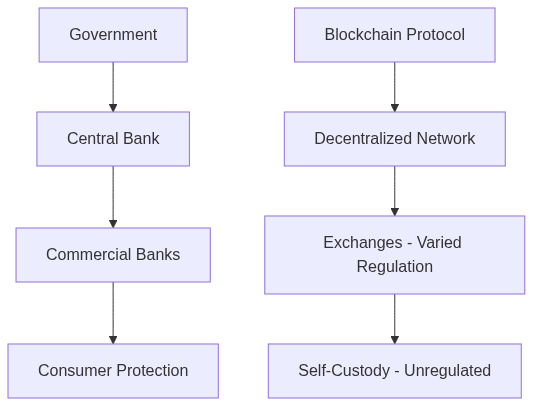
Fiat currency regulation is well established. Central banks control monetary policy. Banking regulators oversee institutions. Deposit insurance protects consumers (up to $250,000 per account in the US via FDIC). The rules are clear, tested, and enforceable.
Crypto regulation is fragmented. The US passed the GENIUS Act in 2025, creating the first federal regulatory framework for stablecoins — but broader cryptocurrency regulation remains patchwork. The EU’s MiCA framework took effect in 2024. Some countries (El Salvador) made Bitcoin legal tender. Others (China) banned crypto trading entirely.
For traders, this regulatory gap translates into real risk. Crypto exchanges can be hacked, freeze withdrawals, or face enforcement actions. In April 2024, Binance’s former CEO Changpeng Zhao received a prison sentence for BSA/AML violations. That kind of counterparty risk doesn’t exist when you’re trading EUR/USD through a regulated forex broker.
Privacy is another dimension. Fiat transactions are logged by banks and accessible to authorities. Crypto transactions are pseudonymous — visible on the blockchain, but not inherently tied to real identities unless an exchange enforces KYC. Neither system is perfectly private, but they lean in opposite directions.
For country-specific rules, read our guide on crypto trading legality by country.
Trading involves significant risk. Cryptocurrency markets are largely unregulated compared to traditional financial markets. Never invest more than you can afford to lose.
What Are CBDCs and How Do They Compare to Crypto?
Stablecoin circulation reached approximately $255 billion in 2025 (TRM Labs, 2025), while central banks worldwide are developing their own digital currencies. The line between “digital fiat” and “crypto” is getting blurry — but the differences remain fundamental.
A central bank digital currency (CBDC) is government-issued digital money. It’s fiat in electronic form — legal tender, centrally controlled, backed by the state. ECB President Christine Lagarde emphasized that a digital euro would remain “a form of fiat currency” backed by the full authority of the central bank. CBDCs use blockchain-inspired technology, but they aren’t decentralized.
Stablecoins (USDT, USDC) occupy the middle ground. They’re cryptocurrencies pegged to fiat values — typically backed by dollar reserves or equivalent assets — issued by private companies, not governments. After the Terra/Luna collapse in 2022 wiped out roughly $40 billion in value, regulators globally pushed for stablecoin oversight closer to banking rules. The US GENIUS Act mandates reserve backing requirements for stablecoin issuers.
So what’s the actual difference? Control. A CBDC is the government’s money in digital form. A stablecoin is a private company’s promise to maintain a peg. A cryptocurrency like Bitcoin is no one’s money — and that’s the point.
For traders, the practical implications vary. CBDCs could eventually provide faster fiat settlement on regulated rails. Stablecoins already offer that — but carry counterparty risk tied to the issuer’s reserves. And Bitcoin sits in a different category entirely: a speculative asset with a fixed supply, not a payment instrument.
How Do Crypto Payment Systems Compare to Fiat Gateways?
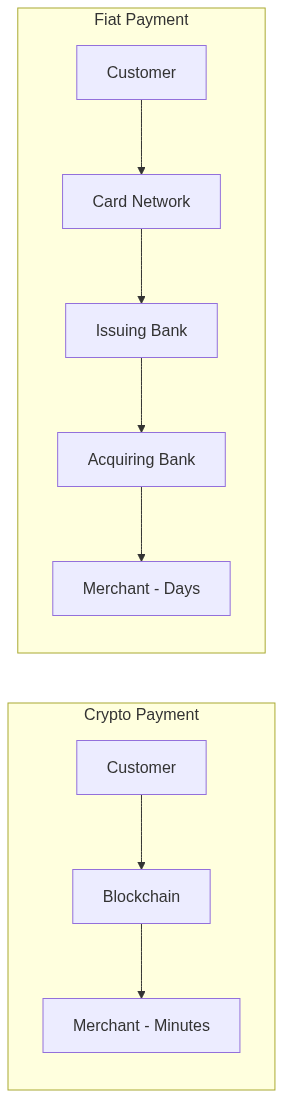
Crypto payment gateways settle transactions in 1 second to 10 minutes with a single intermediary, compared to 1-14 days and multiple intermediaries for traditional fiat payments (Finextra, 2024). That speed advantage drives merchant interest, especially for cross-border payments.
Traditional fiat payments work through layers. A customer swipes a card. The payment passes through the merchant’s bank, the card network (Visa, Mastercard), and the customer’s bank. Each intermediary takes a cut and adds processing time. International wire transfers through SWIFT can take 3-5 business days. Bank fees, interchange charges, and currency conversion costs stack up.
Crypto payment gateways cut through most of that. A customer pays in Bitcoin or a stablecoin. The gateway confirms the transaction on the blockchain — typically minutes for Bitcoin, seconds for networks like Solana or the Lightning Network. Many gateways auto-convert to fiat, so the merchant never holds crypto.
The trade-off? Volatility risk during settlement (mitigated by instant conversion), regulatory uncertainty in some jurisdictions, and the reality that most consumers still prefer card payments. Crypto payments are growing — a 2025 merchant survey found 46% of surveyed businesses accept cryptocurrency (CoinLaw, 2025) — but they’re not replacing fiat payment rails. They’re supplementing them.
What Trading Strategies Work for Both Crypto and Fiat?
The crypto market’s $3.6 trillion total cap (CoinGecko, 2025) represents a growing but still distinct asset class alongside the $7.5 trillion-per-day forex market. Effective traders don’t pick sides — they treat crypto and fiat as complementary exposures within a broader portfolio.
Portfolio diversification is the most straightforward play. Crypto’s price movements show limited long-term correlation with major fiat pairs. When EUR/USD is range-bound for weeks, Bitcoin might be trending hard. A small crypto allocation (5-15% is common among active traders) adds a volatility dimension that pure fiat portfolios lack.
Risk management with stablecoins bridges both worlds. A trader holding a leveraged BTC position can rotate into USDC or USDT during high-uncertainty periods — effectively moving to a dollar position without leaving the crypto ecosystem. It’s faster and cheaper than converting back to fiat through a bank.
Arbitrage opportunities emerge from crypto’s fragmented market structure. Price differences between exchanges — and between crypto pairs denominated in different fiat currencies (BTC-USD vs BTC-KRW) — create windows that don’t exist in the highly efficient interbank forex market. Crypto’s 24/7 hours make these exploitable around the clock.
Regulatory event trading is increasingly relevant. Crypto prices react sharply to ETF approvals, regulatory announcements, and CBDC developments. The 2024 Bitcoin spot ETF approval drove a multi-month rally. Fiat traders already monitor central bank calendars — crypto traders need a similar discipline around regulatory catalysts.
Explore AI-powered crypto trading tools that help manage both asset classes. And if you’re evaluating where to trade, see our guide to choosing a trading platform.
Cryptocurrency vs Fiat: Key Differences at a Glance
| Feature | Fiat Currency | Cryptocurrency |
|---|---|---|
| Issuer | Central bank / government (legal tender) | Decentralized network / protocol (no single authority) |
| Legal status | Government-backed, accepted for all debts | Not legal tender in most countries; classified as digital asset |
| Volatility | Low — ~2% inflation target, 5-10% FX moves | High — 50-80% annualized for BTC |
| Supply | Expandable (central bank monetary policy) | Often fixed or algorithmic (Bitcoin: 21M cap) |
| Market hours | Forex 24/5, equities variable | 24/7/365 |
| Liquidity | Extremely high for majors ($7.5T daily forex) | Variable — high for BTC/ETH, thin for altcoins |
| Transaction speed | Bank transfers: hours to days | Blockchain: seconds to minutes |
| Transaction fees | Bank/intermediary fees, interchange charges | Network fees (variable by chain) |
| Regulation | Mature, well-established oversight | Evolving, fragmented across jurisdictions |
| Privacy | Limited — banks log all activity | Pseudonymous — public ledger, private identity |
The Bottom Line on Cryptocurrency vs Fiat for Traders
Cryptocurrency and fiat currency aren’t competing to replace each other — they’re evolving in parallel. With 861 million crypto holders and $7.5 trillion in daily forex volume, both asset classes are too large and too embedded to ignore. The traders who perform best treat them as complementary tools, not ideological camps.
The practical takeaway: understand the structural differences (supply mechanics, volatility profile, regulatory maturity), size your exposure according to your risk tolerance, and stay current on regulatory shifts that can move crypto markets overnight. Neither asset class is “better.” They serve different roles in a portfolio.
If you’re ready to go deeper, explore our complete crypto guides for strategy-specific coverage.
Frequently Asked Questions
How many people use cryptocurrency globally?
Approximately 861 million people held cryptocurrency in 2025, roughly 11% of the global population (Chainalysis Global Adoption Index, 2025). India leads with about 150 million users, followed by the United States. Adoption is growing fast but remains a fraction of fiat usage.
Is cryptocurrency safer than fiat currency?
Neither is inherently “safer” — they carry different risks. Fiat deposits in regulated banks are protected by deposit insurance (FDIC covers up to $250,000 in the US). Crypto has no equivalent safety net. Exchanges can be hacked, wallets can be lost, and there’s no central authority to reverse fraudulent transactions. Fiat carries inflation risk; crypto carries volatility and counterparty risk.
What are stablecoins and how do they bridge crypto and fiat?
Stablecoins are cryptocurrencies pegged to fiat currency values — typically the US dollar. USDT and USDC, the two largest, maintain a 1:1 dollar peg backed by reserve assets. They combine crypto’s fast settlement with fiat’s price stability, making them useful for trading, cross-border payments, and parking funds during volatile markets.
Are cryptocurrencies legal?
Legality varies by country. Most major economies (US, EU, UK, Japan, Australia) permit crypto trading under evolving regulatory frameworks. Some countries, including China and a handful of others, restrict or ban crypto transactions. The EU’s MiCA regulation and the US GENIUS Act (both 2024-2025) represent the most comprehensive regulatory efforts to date.
How do crypto transaction fees compare to fiat?
It depends on the blockchain and the fiat payment method. Bitcoin transactions cost $1-5 on average but spike during network congestion. Layer-2 networks and chains like Solana process transactions for fractions of a cent. International wire transfers via SWIFT cost $25-50 and take days. Domestic card payments cost merchants 1.5-3.5% per transaction in interchange fees.
About Author