What Are Trump Tariffs and How Have They Affected Global Trade?
 Robert J. Williams
  Alexandra Winters
In my guide to Trump tariffs and their far-reaching consequences, I want to cut through the noise. Between January and April 2025, the average effective U.S. tariff rate rose from 2.5% to roughly 27% — the highest level in over a century (Tax Foundation, 2025). Then, in February 2026, the Supreme Court struck down the most aggressive of those tariffs in a 6-3 ruling. The fallout reshaped trade policy, rattled financial markets, and sent Bitcoin sliding 26% in a matter of months.
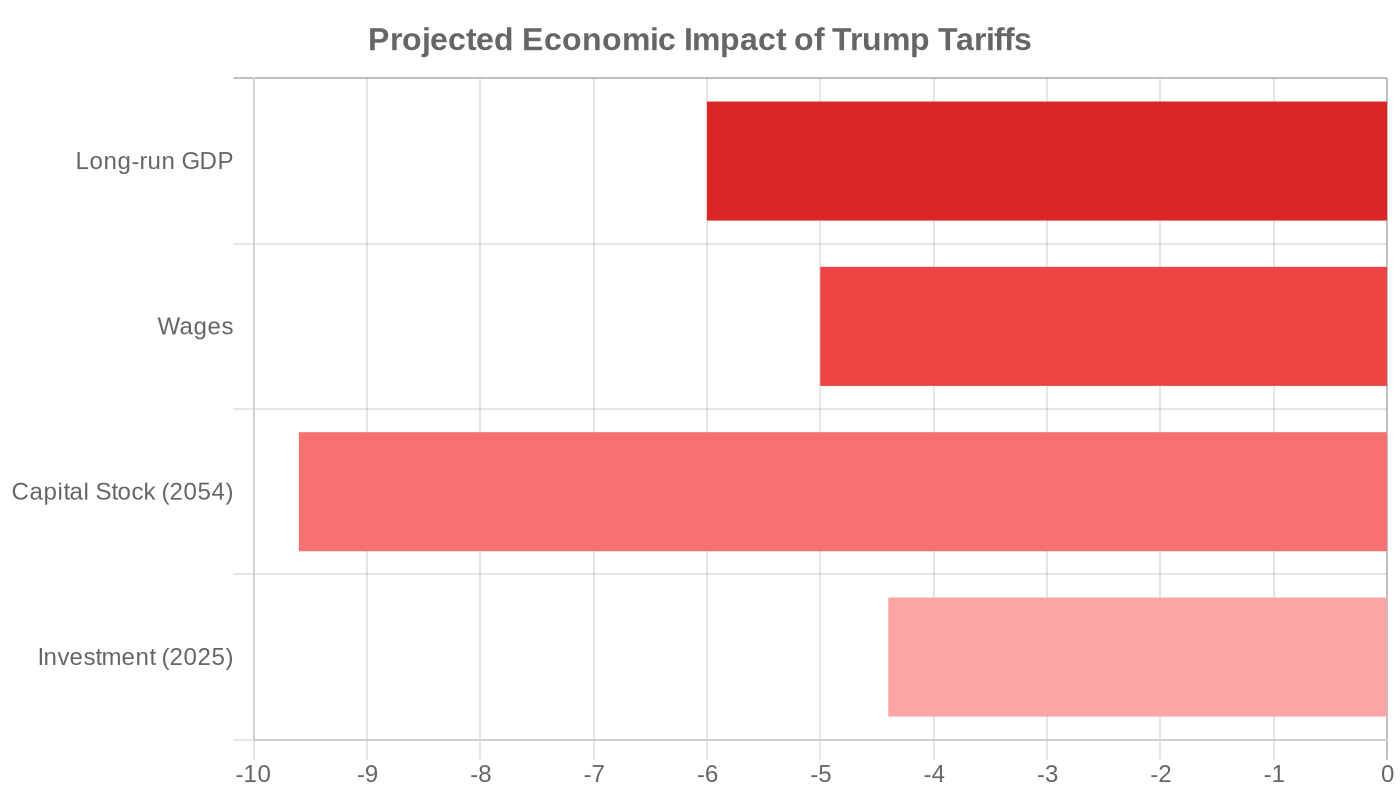
“Virtually all economists think that the impact of the tariffs will be very bad for America and for the world,” Nobel laureate Joseph Stiglitz said in a February 2026 interview with Democracy Now!. He wasn’t exaggerating. The Penn Wharton Budget Model projects a long-run GDP reduction of roughly 6% and a wage decline of 5%.
This guide walks through how these tariffs originated, what the Supreme Court ruling changed, and why it matters for investors watching both traditional markets and crypto.
Trump tariffs pushed U.S. import duties to 27%, the highest since the 1930s (Tax Foundation, 2025). The Supreme Court struck down IEEPA-based tariffs in February 2026, but a 10% global tariff remains under Section 122. Costs range from $700 to $1,500 per household annually, and Bitcoin dropped 26% amid tariff-driven uncertainty.
What Are Trump Tariffs?
Trump tariffs are import taxes imposed by President Donald Trump, first during his 2018-2020 term and then again from 2025 onward. According to the Tax Foundation (2026), these tariffs represent the largest U.S. tax increase as a percentage of GDP since 1993. They were designed to protect American manufacturing and reduce trade deficits, though their actual economic effects have been far more complicated.
The legal authority came from three main statutes. Section 232 of the Trade Expansion Act of 1962 allowed tariffs on imports deemed national security threats — that’s how steel (25%) and aluminum (10%) duties were justified starting in March 2018. Section 301 of the Trade Act of 1974 permitted duties to counter unfair foreign trade practices, covering roughly $360 billion in Chinese imports by late 2019.
Then came the controversial move. In April 2025, the administration invoked the International Emergency Economic Powers Act (IEEPA) to impose “Liberation Day” tariffs of 10-50% on imports from nearly all countries. That legal stretch ultimately landed before the Supreme Court.
Worth noting: tariffs aren’t paid by China or any other exporting country. The New York Federal Reserve found that 86-94% of tariff costs fall on American firms and consumers. The “other countries pay” framing was always misleading.
How Did Trump’s Tariffs Evolve From 2018 to 2026?
The tariff story spans two presidential terms and eight years of escalation, negotiation, and legal challenge. From the initial steel duties to the Supreme Court showdown, here’s how the policy evolved (Tax Foundation, 2026):
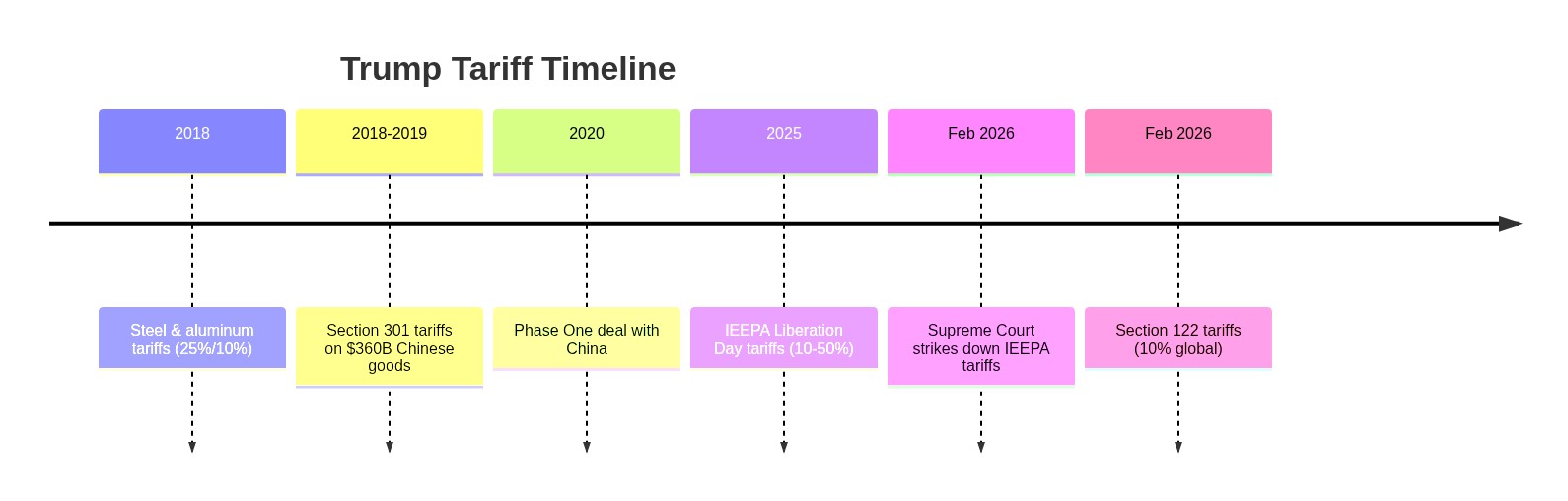
First term (2018-2020): Steel and aluminum tariffs hit in March 2018. Section 301 tariffs on China followed in waves, eventually covering 15-20% of all U.S. imports. The “Phase One” trade deal, signed in January 2020, paused escalation but left most duties intact.
Biden era (2021-2024): Contrary to expectations, the Biden administration kept most Trump-era tariffs. Roughly $350 billion in Chinese import duties remained, used as leverage in ongoing negotiations. The bipartisan consensus against unfettered free trade had shifted.
Second term (2025-2026): Trump returned to office and went further than before. IEEPA-based tariffs raised the average effective rate from 2.5% to 27%. The scope was unprecedented — almost every trading partner faced new or increased duties. But the legal basis was shaky, and the courts eventually agreed.
What Did the Supreme Court Rule on Trump’s Tariffs?
On February 20, 2026, the Supreme Court ruled 6-3 in Learning Resources, Inc. v. Trump that IEEPA does not authorize the president to impose tariffs (SCOTUSblog, 2026). Chief Justice Roberts, joined by Justices Sotomayor, Kagan, Gorsuch, Barrett, and Jackson, found the administration exceeded its authority. More than $160 billion in tariffs had been collected under IEEPA before the ruling.
The decision didn’t touch everything. Section 232 tariffs on steel, aluminum, and autos remain in place. Section 301 tariffs on Chinese goods remain in place. What got struck down were the broad “Liberation Day” tariffs and the reciprocal tariff regime that had pushed rates to historic highs.
“All Trump’s tariffs have done is impose a sales tax on Americans, create uncertainty, if not chaos, in international markets, and turn friends into enemies,” Steve Hanke, professor of applied economics at Johns Hopkins University, wrote in Fortune (February 2026).
Within hours of the ruling, the president signed an executive order invoking Section 122 of the Trade Act of 1974, imposing a 10% tariff on most imports for 150 days — through July 24, 2026. Treasury Secretary Scott Bessent then signaled the rate could rise to 15%.
So the tariffs didn’t disappear. They got smaller and shifted to different legal ground.
How Have Trump Tariffs Affected the U.S. Economy?
According to the Penn Wharton Budget Model (April 2025), Trump’s tariffs are projected to reduce long-run U.S. GDP by approximately 6% and wages by about 5%. The study found that a middle-income household faces a lifetime loss of roughly $22,000 from tariff-related economic distortion.
Manufacturing and Jobs
The manufacturing picture is mixed at best. Steel and aluminum tariffs created modest job gains in metal production, but at an estimated cost of $900,000 per job saved. A Federal Reserve study found net job losses of 75,000 across the manufacturing sector — because higher input costs hurt more businesses than the tariffs protected.
Factories shed 108,000 jobs in 2025 alone. Research from Trump’s first term showed that import tariffs had “neither a sizable nor significant effect on U.S. employment” in protected sectors, while foreign retaliation “had clear negative employment impacts, particularly in agriculture.”
Agriculture
Farmers bore some of the heaviest costs. U.S. soybean exports to China fell 53.3% in 2018 after retaliatory tariffs hit. Corn, pork, and dairy exports also took significant hits as China targeted products with maximum political impact — many from states that supported the tariff policies.
The federal government stepped in with $28 billion in aid over 2018-2019, the largest farm bailout in American history. By 2019, government payments made up one-third of total farm income — a level of dependence that troubled even tariff supporters. The long-term damage may be worse than the short-term losses: Chinese buyers found alternative suppliers in Brazil, Argentina, and Australia, and some of those relationships stuck.
Automotive
Ford reported $1 billion in profit losses from metal tariff costs during the first term. Higher manufacturing expenses cut into export competitiveness and pushed consumer car prices higher. The auto sector illustrates the chain reaction: tariffs on raw materials cascade through supply chains, making finished goods more expensive at every step. For traders using forex brokers to trade currency pairs affected by trade policy, these supply-chain shifts create both risk and opportunity.
What Is the Cost of Tariffs for American Households?
The Tax Foundation (2026) estimates that Trump tariffs amount to an average tax increase of $700 per U.S. household. The Yale Budget Lab puts the figure higher — up to $1,500 annually. Nobel economist Joseph Stiglitz estimated the range at $1,000-$1,700 per family.
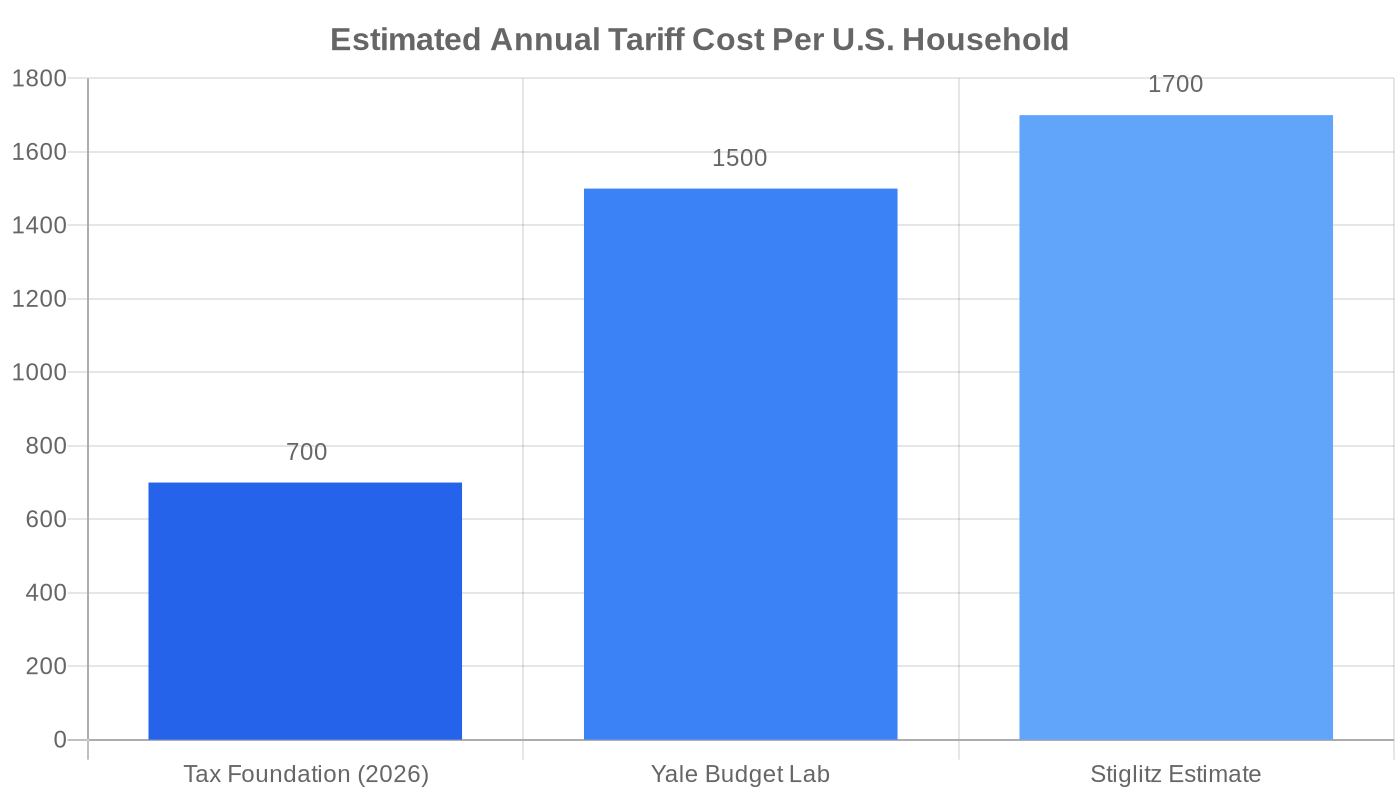
These aren’t abstract numbers. Nearly all the tariff burden lands on American importers, who pass costs through supply chains to consumers. Goldman Sachs estimates that nearly 70% of tariff costs will ultimately reach consumers as higher prices. Imported goods prices rose 1.3-1.4% through December 2025, according to PCE data — well above pre-tariff trends.
After the Supreme Court ruling eliminated the highest IEEPA tariffs, the remaining duties (Section 232, Section 301, and the new Section 122 tariff) still cost an estimated $400-$600 per household. The bills got smaller but didn’t disappear.
How Did Other Countries Respond to Trump’s Tariffs?
According to J.P. Morgan Global Research (2026), retaliation came swiftly and from multiple directions. The IMF estimated a potential 1% global GDP reduction from a 10% universal tariff combined with retaliatory measures. Here’s how the major trading partners responded:
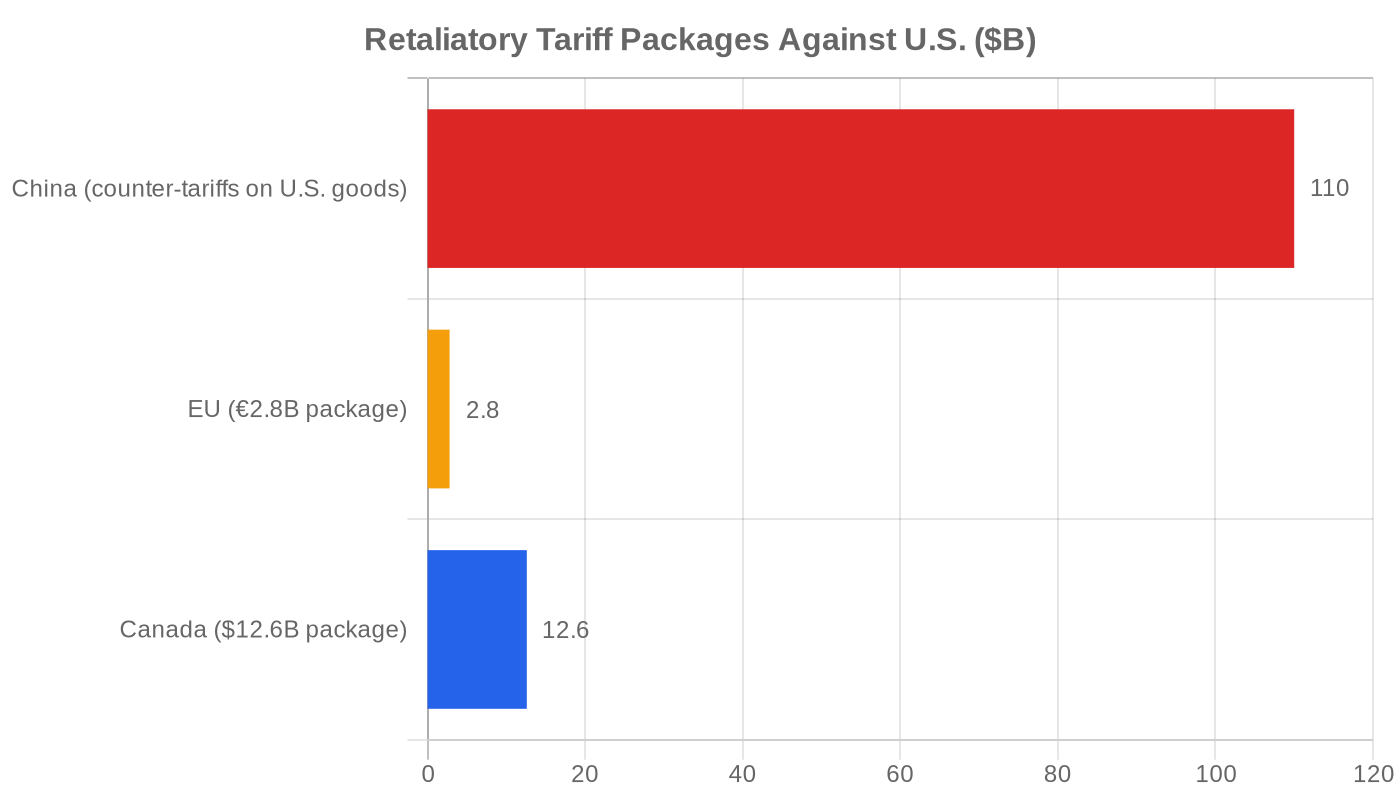
China hit back hardest, imposing counter-tariffs on U.S. agricultural and industrial exports. The trade war wiped out decades of market-building for American farmers in China. The Phase One deal (2020) paused escalation without resolving the core disputes.
Canada rolled out a $12.6 billion tariff package targeting American goods. Both Canada and Mexico eventually negotiated partial relief through USMCA ratification, but not before significant supply-chain disruption across North America’s integrated auto and manufacturing sectors.
The European Union retaliated with €2.8 billion in counter-tariffs on politically symbolic American products — bourbon, motorcycles, jeans. The threat of auto tariffs created persistent uncertainty for European manufacturers.
A less visible but equally significant shift: trade diversion. As U.S.-China trade shrank, imports didn’t disappear — they rerouted through Vietnam, India, and Mexico. Chinese goods sometimes arrived via intermediate countries with minimal processing, technically avoiding tariffs while the underlying supply chain barely changed.
The bilateral deficit with China fell, but the total U.S. trade deficit stayed large and even grew as a share of GDP. Tariffs reshuffled supply chains without fixing the underlying imbalance. Many economists argue the trade deficit reflects macroeconomic factors — savings rates, capital flows, fiscal policy — that tariffs can’t address.
How Have Trump Tariffs Impacted Crypto and Bitcoin?
Bitcoin fell as much as 26% during 2025-2026, with tariff-related uncertainty acting as a significant headwind (CNBC, February 2026). When Trump floated a 100% tariff on Chinese imports tied to rare-earth tensions, $19 billion was wiped out in forced liquidations across crypto exchanges in a single day.
“The sudden uptick in tariff rates is causing investors to sell crypto assets in anticipation of a more serious market decline,” Jeff Mei, COO of crypto exchange BTSE, told crypto.news in 2026.
The mechanism is straightforward. In the short term, Bitcoin behaves as a risk asset, not a safe haven. Tariff shocks trigger risk-off moves across equities, commodities, and crypto simultaneously. Institutional investors who treat Bitcoin as a growth allocation reduce exposure when economic uncertainty spikes.
But the long-term picture looks different. Tariffs weaken the dollar’s purchasing power and erode trust in the existing trade architecture. If the dollar’s dominance as a reserve currency faces sustained challenge — and tariff policies have given trading partners reason to diversify — Bitcoin’s narrative as an alternative store of value gains credibility. Several major tariff risks line up for 2026: China, Europe, and baseline import duties, with each move potentially shifting liquidity and risk sentiment.
Is Bitcoin a hedge against tariff chaos? Not in the way gold has been historically. Bitcoin’s correlation with risk assets means it drops first and recovers later. But over multi-year timeframes, the erosion of trust in the traditional trade system creates structural demand for alternatives. That’s the bull case, anyway — and it’s one that more institutional investors are starting to take seriously.
For crypto traders watching tariff developments, the pattern so far has been: announcement shock causes sharp drops, followed by gradual recovery as markets price in the new reality. The Supreme Court ruling in February 2026 initially pushed prices higher as trade uncertainty appeared to ease — then the Section 122 replacement tariffs brought fresh volatility. If you’re exploring how to get started, check out our guide to starting Bitcoin trading. And if you’re trading crypto, don’t forget the tax implications — our crypto taxation guide covers what you need to know. For comparing trading platforms, we’ve reviewed the top options.
What Is the Current State of U.S. Tariff Policy?
As of March 2026, the U.S. tariff landscape sits on uncertain legal and political ground. The effective tariff rate dropped from its peak of ~27% to approximately 13.7% after the Supreme Court ruling (Tax Foundation, February 2026). Here’s what remains in force:
Still active:
- Section 232 tariffs: 25% on steel, 10% on aluminum, tariffs on autos and derivatives — untouched by the Supreme Court
- Section 301 tariffs: Duties on ~$350 billion in Chinese imports — maintained under both Trump and Biden
- Section 122 tariffs: 10% on most imports, effective February 24, 2026, valid for 150 days (through July 24, 2026)
Struck down:
- IEEPA “Liberation Day” tariffs (10-50% on most imports)
- IEEPA reciprocal tariffs on specific countries
- More than $160 billion collected under IEEPA awaiting potential refund proceedings
The Congressional Budget Office projected that the loss of IEEPA tariff revenue would increase the federal deficit by $2 trillion, while potentially lowering inflation and unemployment. The CBO essentially said: fewer tariffs mean a bigger deficit but a healthier economy.
The Section 122 authority is temporary — Congress can extend it, but the 150-day clock is ticking. Whether tariffs return to their 2025 peaks depends entirely on whether Congress grants new authority. That’s a political question, not an economic one.
What’s clear is that tariffs have become a normalized tool of American trade policy. Both parties now accept some level of protectionism. The WTO’s role has diminished as nations pursue bilateral deals. And supply chains that diversified during the tariff era aren’t coming back to their pre-2018 configurations. The genie is out of the bottle.
Trump Tariffs and Global Trade: What It Means for Investors
Trump tariffs reshaped the global trade system in ways that won’t fully reverse regardless of policy changes. The Penn Wharton Budget Model’s projection of a 6% long-run GDP decline and $22,000 lifetime loss per middle-income household underscores the scale of disruption (Penn Wharton, 2025). For investors in both traditional markets and crypto, the implications are structural: supply chains have permanently diversified, the dollar’s reserve-currency status faces more scrutiny, and policy uncertainty is now a baseline condition rather than an anomaly.
The next move belongs to Congress. If Section 122 expires without replacement, tariffs drop to pre-2025 levels on most goods. If Congress grants new authority, another round of escalation is possible. Either way, understanding how tariffs work — and who actually pays for them — is essential for making informed investment decisions. Explore our full library of crypto guides for more on navigating volatile markets.
Risk disclaimer: This article is for educational purposes only and does not constitute financial, investment, or trading advice. Tariff policy changes can create significant market volatility. Always conduct your own research and consider consulting a licensed financial advisor before making investment decisions.
Frequently Asked Questions
Are Trump tariffs still in effect in 2026?
Yes, but with significant changes. The Supreme Court struck down IEEPA-based tariffs in February 2026, removing the broadest tariff regime. Section 232 tariffs on steel, aluminum, and autos remain fully in force. Section 301 tariffs on Chinese imports (~$350 billion) continue. A new 10% global tariff under Section 122 took effect February 24, 2026, valid for 150 days.
Who pays for tariffs — the U.S. or exporting countries?
American firms and consumers bear the vast majority of tariff costs. The New York Federal Reserve (2026) found that 86-94% of tariff costs fall on U.S. importers, not foreign exporters. These costs get passed through supply chains as higher prices for businesses and consumers.
How do tariffs affect cryptocurrency prices?
Tariffs create economic uncertainty, which typically pushes investors toward risk-off positions — selling crypto alongside equities. Bitcoin dropped 26% during the 2025-2026 tariff escalation. However, tariffs can benefit crypto long-term by weakening the dollar and eroding trust in traditional trade systems, strengthening Bitcoin’s alternative store-of-value narrative.
What was the Supreme Court tariff ruling?
On February 20, 2026, the Supreme Court ruled 6-3 in Learning Resources, Inc. v. Trump that the International Emergency Economic Powers Act (IEEPA) does not authorize the president to impose tariffs. The ruling struck down “Liberation Day” tariffs and reciprocal tariffs, while leaving Section 232 and Section 301 tariffs intact.
How much do tariffs cost the average American family?
Estimates range from $700 to $1,700 annually, depending on the source and methodology. The Tax Foundation estimates $700 per household (2026), the Yale Budget Lab puts it at $1,500, and Nobel economist Joseph Stiglitz estimated $1,000-$1,700. After the Supreme Court ruling reduced tariff rates, remaining costs sit at roughly $400-$600 per household.
About Author