The punishment for forex trading in India depends entirely on how you trade. Under FEMA Section 13, unauthorized forex activity carries fines up to three times the transaction amount or Rs 2 lakh — whichever is higher — plus Rs 5,000 for every additional day the violation continues (FEMA 1999, Section 13). Serious offenders face up to five years in prison.
That’s the short version. The longer answer involves understanding what counts as “unauthorized,” who enforces these rules, and how to stay on the right side of India’s forex regulations.
India’s foreign exchange market has grown to approximately $60 billion in daily turnover (RBI Governor statement, 2024), making it a significant market. But the RBI and SEBI maintain strict controls over who can participate and how. If you’re wondering whether forex trading is legal in India, the answer is yes — but only through approved channels.
Illegal forex trading in India carries FEMA penalties of up to 3x the transaction amount, daily fines of Rs 5,000, and up to 5 years imprisonment under Section 13(1C). Legal trading is restricted to INR-based pairs on NSE, BSE, or MSE through SEBI-registered brokers. The RBI’s alert list now flags 95 unauthorized platforms (as of November 2025).
What Penalties Does FEMA Impose for Illegal Forex Trading?
Under FEMA Section 13, penalties for unauthorized forex trading can reach three times the transaction amount or Rs 2 lakh, whichever is higher, with an additional Rs 5,000 per day for continuing violations (FEMA 1999). These aren’t theoretical numbers — the Enforcement Directorate actively pursues cases.
Here’s how the penalty structure breaks down:
| Violation Type | Penalty | Legal Basis |
|---|---|---|
| Trading via unlicensed platform | Up to 3x transaction amount or Rs 2 lakh (whichever higher) | FEMA Section 13(1) |
| Continued violation | Rs 5,000 per day beyond initial offense | FEMA Section 13(1) |
| Serious/willful violation | Up to 5 years imprisonment + fine | FEMA Section 13(1C) |
| Asset involvement | Confiscation and freezing of assets | FEMA Section 13(2) |
| Minor/procedural violation | Capped at Rs 2 lakh (with voluntary correction) | FEMA Amendment, April 2025 |
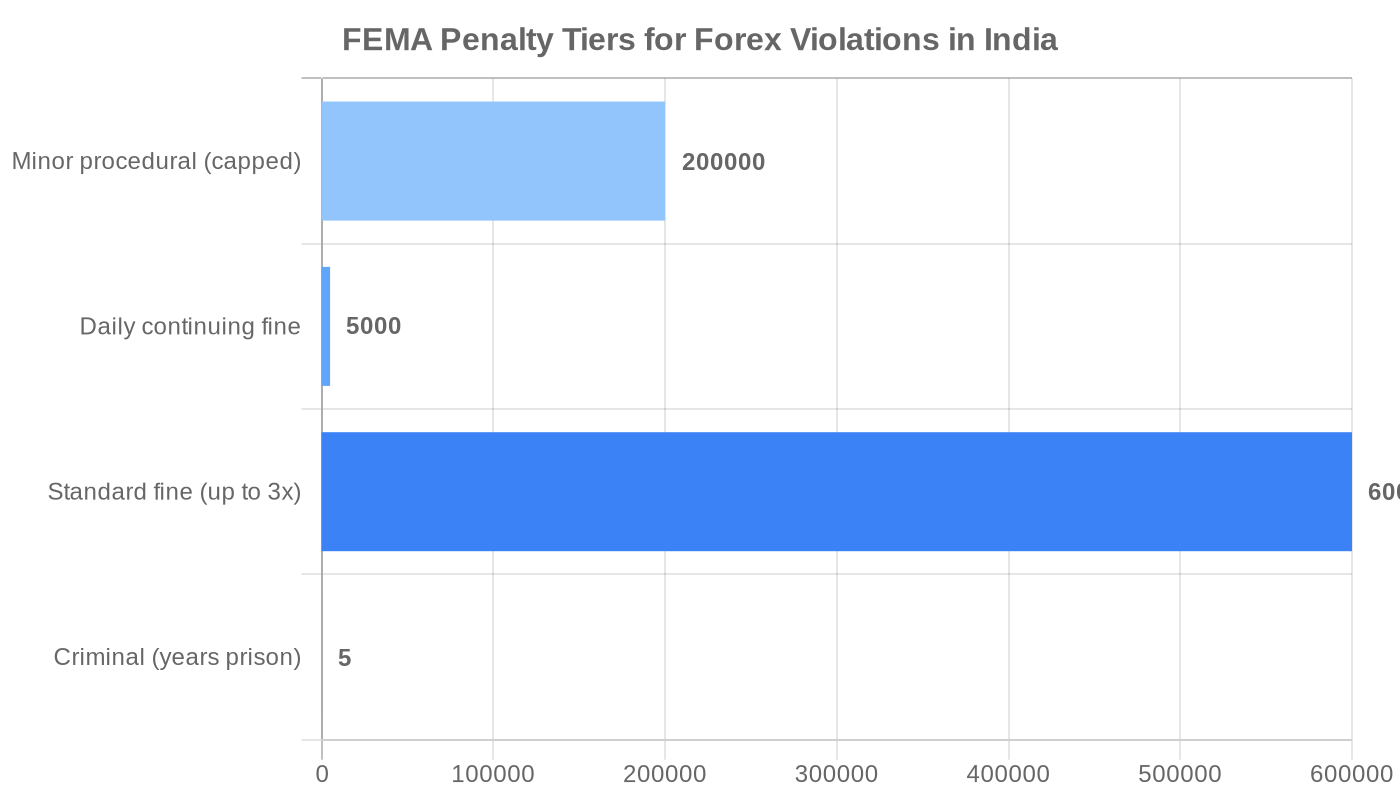
The April 2025 amendment introduced an important distinction. Minor, technical, or procedural FEMA violations — where there’s no willful default or fraud and the individual voluntarily takes corrective action — now face a capped penalty of Rs 2 lakh. That’s a meaningful change for traders who unknowingly used a non-compliant platform and self-reported.
But don’t confuse leniency on minor violations with a soft stance overall. Deliberate violations still carry the full weight of FEMA Section 13, and the daily compounding penalty means even short stretches of illegal trading rack up significant fines. Trade illegally for a month, and the Rs 5,000/day penalty alone hits Rs 1.5 lakh — before the primary fine is even calculated.
Can You Go to Jail for Forex Trading in India?
Yes. Under FEMA Section 13(1C), individuals who contravene forex regulations may face imprisonment for a term extending to five years along with a fine (FEMA 1999). This isn’t a blanket sentence for every violation, though. Criminal prosecution typically targets serious cases.
What triggers criminal charges rather than just fines? The threshold isn’t explicitly defined in the statute, but enforcement patterns point to several escalation factors:
- Scale of the violation — large transaction amounts signal organized activity, not accidental non-compliance
- Repeat offenses — continued trading after receiving a warning or penalty order
- Connection to money laundering — forex violations tied to PMLA (Prevention of Money Laundering Act) offenses get fast-tracked
- Failure to appear or comply — ignoring ED summons or adjudication orders
“Any person who makes any statement or furnishes any information knowing it to be false, or who participates in illegal remittances, may be liable for prosecution,” the Enforcement Directorate notes in its FEMA enforcement guidelines.
The practical reality: most first-time individual traders who used an offshore platform don’t face prison. They face fines and asset freezes. Jail time is reserved for repeat offenders, those operating unauthorized platforms, and cases involving large sums or fraud.
How Does India Enforce Forex Trading Laws?
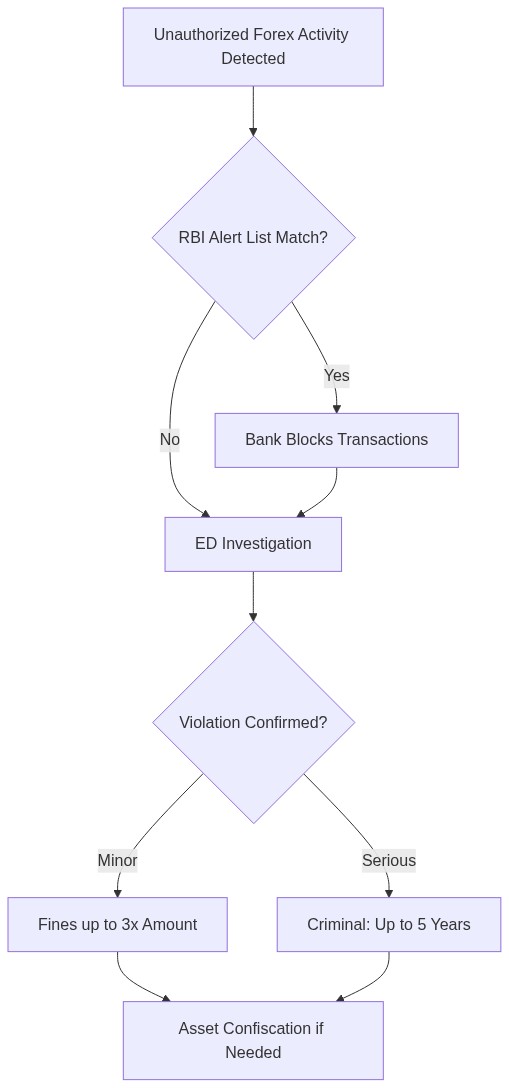
The Reserve Bank of India maintains an alert list that now includes 95 unauthorized forex trading platforms as of its November 2025 update, having added seven new entities including Starnet FX, CapPlace, Mirrox, Fusion Markets, Trive, NXG Markets, and Nord FX (RBI Alert List, November 2025). This list is publicly available and regularly updated.
Enforcement operates through a three-agency structure:
Reserve Bank of India (RBI) — Sets forex regulations, maintains the alert list of unauthorized platforms, and issues directives to banks. When the RBI flags a platform, banks are required to block transactions to and from that entity.
Securities and Exchange Board of India (SEBI) — Regulates authorized exchanges (NSE, BSE, MSE) and licenses brokers for currency derivatives trading. SEBI can impose penalties on brokers who facilitate unauthorized trading.
Enforcement Directorate (ED) — The investigation and enforcement arm for FEMA violations. The ED has powers to:
- Issue summons and conduct searches
- Attach and confiscate assets connected to violations
- Initiate adjudication proceedings for penalties
- Refer cases for criminal prosecution
The RBI has explicitly warned that its alert list “is not exhaustive” — a platform not being on the list doesn’t mean it’s approved. The absence of a name doesn’t equal authorization, which is a point many traders misunderstand.
What Makes Forex Trading Illegal in India?
Under Indian law, forex trading becomes illegal when it occurs outside the regulatory framework established by the RBI and SEBI. India permits only exchange-traded currency derivatives through authorized channels — not spot forex trading through offshore platforms (RBI FAQs on Forex).
The line between legal and illegal is drawn at three points:
1. Platform authorization. Trading must happen on recognized Indian exchanges — the NSE, BSE, or MSE currency derivatives segments. Using offshore brokers like those flagged on the RBI’s alert list is a FEMA violation, regardless of whether the broker is regulated elsewhere.
2. Currency pair restrictions. Indian residents can trade only these pairs:
| Category | Permitted Pairs |
|---|---|
| INR base pairs | USD/INR, EUR/INR, GBP/INR, JPY/INR |
| Approved cross-currency (derivatives only) | EUR/USD, GBP/USD, USD/JPY |
Trading EUR/GBP, AUD/USD, or any pair not on this list is prohibited for Indian residents. Cross-currency pairs were added in 2018 and are permitted only as exchange-traded derivatives — not spot trading.
3. Remittance restrictions. The RBI’s Liberalised Remittance Scheme (LRS) explicitly bans sending money abroad for margin trading or overseas forex speculation. Even if you have LRS headroom, using it to fund an international forex account violates FEMA.
What about CFDs and binary options? Both are illegal for Indian residents regardless of the underlying currency pair. These instruments aren’t available on Indian exchanges, so any platform offering them to Indian traders is operating outside the law.
Which Currency Pairs Are Legal for Indian Traders?
Indian traders can legally trade seven currency pairs — four INR-based pairs and three cross-currency derivatives — on recognized exchanges through SEBI-registered brokers (SEBI Circular on Currency Derivatives). This is the complete list as of 2026.
| Pair | Type | Available As |
|---|---|---|
| USD/INR | INR base | Futures + Options |
| EUR/INR | INR base | Futures + Options |
| GBP/INR | INR base | Futures + Options |
| JPY/INR | INR base | Futures + Options |
| EUR/USD | Cross-currency | Futures only |
| GBP/USD | Cross-currency | Futures only |
| USD/JPY | Cross-currency | Futures only |
The cross-currency pairs (EUR/USD, GBP/USD, USD/JPY) were added in 2018 after SEBI expanded the scope of exchange-traded currency derivatives. They’re available as futures contracts only — no options. And they must be traded on Indian exchanges, not through offshore platforms.
Why so few pairs? The RBI restricts forex trading to protect India’s foreign exchange reserves and maintain currency stability. Allowing unlimited pair trading through offshore platforms would create unregulated capital outflows — something the central bank actively works to prevent.
How Do You Trade Forex Legally in India?
Legal forex trading in India requires a SEBI-registered broker, an Indian bank account, completed KYC documentation, and trades executed exclusively on NSE, BSE, or MSE currency derivative segments. Follow these steps:
Step 1 — Choose a SEBI-registered broker. Verify the broker’s registration on SEBI’s intermediary database. Several brokers offer currency derivatives trading — check out our list of SEBI-registered forex brokers or RBI-approved forex trading apps for vetted options.
Step 2 — Complete KYC. You’ll need PAN card, Aadhaar, proof of address, and an Indian bank account linked to your trading account. This isn’t optional — it’s a regulatory requirement.
Step 3 — Fund through Indian banking channels. All funds must route through your linked Indian bank account. No international wire transfers to offshore brokers.
Step 4 — Trade only permitted pairs. Stick to the seven approved currency pairs on authorized exchanges. If a platform offers you EUR/GBP or AUD/USD, that’s your signal to leave.
Step 5 — Report income properly. Forex trading profits are taxable. Failure to report them invites additional penalties from the Income Tax Department — on top of any FEMA issues.
Want to learn more about the practical steps? Our guide on how to start forex trading in India walks through the process in detail. For timing your trades, see best forex trading time in India.

How Is Forex Trading Income Taxed in India?
Profits from currency derivatives trading on recognized exchanges are taxed under Indian income tax law. The classification depends on how frequently you trade and whether the Income Tax Department treats your activity as speculative or non-speculative business income (Income Tax Act, Section 43(5)).
| Trading Activity | Tax Classification | Tax Rate |
|---|---|---|
| Intraday currency futures (no delivery) | Speculative business income | Individual slab rate |
| Currency futures (carried forward) | Non-speculative business income | Individual slab rate |
| Currency options | Non-speculative business income | Individual slab rate |
Key distinctions:
Speculative income can only be offset against other speculative income — not against salary, business profits, or capital gains. Non-speculative trading losses, however, can be offset against other business income and carried forward for up to 8 years.
Traders must report forex profits in their Income Tax Return (ITR). Using ITR-3 is standard for individuals with business income from trading. If you earn more than Rs 1 crore in turnover from currency trading, a tax audit under Section 44AB becomes mandatory.
Not reporting forex income isn’t just a tax issue. The Income Tax Department shares data with the ED. Unreported forex profits from offshore platforms can trigger both a tax investigation and a FEMA inquiry simultaneously — a situation you really don’t want to be in.
The Bottom Line on Forex Trading Penalties in India
The punishment for forex trading in India ranges from Rs 2 lakh fines to five years in prison, depending on the severity of the FEMA violation. Legal trading through SEBI-registered brokers on recognized exchanges carries no special penalty — profits are simply taxed as income. The RBI’s growing alert list (95 platforms as of November 2025) signals that enforcement is tightening, not loosening.
For traders who want to participate in India’s $60 billion daily forex market without legal risk, the path is straightforward: SEBI broker, approved pairs, Indian exchange. Anything else isn’t worth the penalty.
Explore our guide to forex trading apps for professionals in India to find compliant platforms that fit your trading style.
Frequently Asked Questions
Is forex trading legal in India?
Forex trading is legal in India when conducted through SEBI-registered brokers on recognized exchanges like NSE, BSE, or MSE. Only seven currency pairs are permitted — four INR-based pairs and three cross-currency derivatives. Trading through offshore platforms or in non-approved pairs violates FEMA and carries penalties including fines and potential imprisonment.
Which currency pairs can Indians legally trade?
Indian residents can trade USD/INR, EUR/INR, GBP/INR, and JPY/INR as futures and options. Three cross-currency pairs — EUR/USD, GBP/USD, and USD/JPY — are available as futures only on Indian exchanges. These seven pairs are the complete legal list as of 2026.
Can Indian residents use international forex brokers?
No. Indian regulations prohibit residents from trading forex through foreign brokers or offshore platforms. Using overseas brokers violates FEMA, and the RBI’s Liberalised Remittance Scheme explicitly bans remittances for margin trading or forex speculation abroad. Penalties include fines up to three times the transaction amount.
What is the RBI alert list for forex platforms?
The RBI maintains a publicly available alert list of entities not authorized to deal in forex or operate electronic trading platforms in India. As of November 2025, the list includes 95 unauthorized platforms. The RBI warns the list isn’t exhaustive — a platform’s absence doesn’t imply approval. Check the list at rbi.org.in before using any trading platform.
How is forex trading income taxed in India?
Profits from currency derivatives on Indian exchanges are taxed as business income at your individual slab rate. Intraday futures profits are classified as speculative income, while carried-forward futures and options profits count as non-speculative business income. All forex earnings must be reported in your ITR, and turnover above Rs 1 crore requires a tax audit.
Disclaimer: This article is for educational purposes only and does not constitute legal or financial advice. Forex trading involves risk and is subject to regulatory restrictions. Consult a qualified legal or financial professional before engaging in forex trading. Regulations may change — verify current rules with RBI and SEBI directly.
About Author