GU in forex is trader shorthand for the GBP/USD currency pair — the British pound against the US dollar. You’ll see “GU” in chat rooms, signal groups, and order tickets because typing two letters beats typing seven. The pair also goes by “Cable,” a nickname with roots in 19th-century telegraph lines.
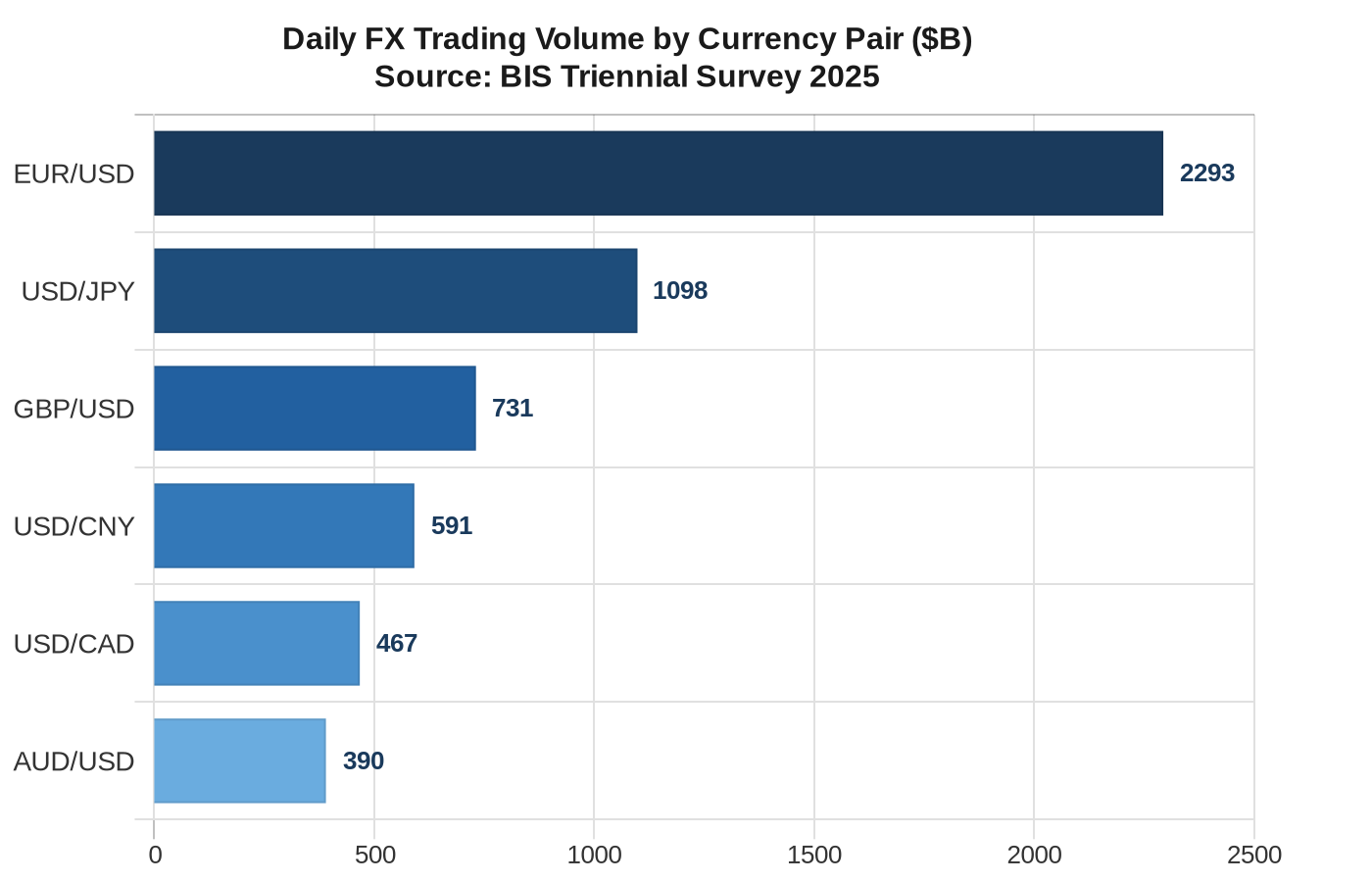
GBP/USD ranks as the fourth most traded currency pair globally, turning over $731 billion per day according to the BIS 2025 Triennial Survey. That volume matters for anyone considering this pair — it means tight spreads, fast execution, and enough liquidity to absorb large orders without slippage.
In my guide to GU in forex, I’ll cover what drives the pair, when the best trading windows open, and how volatility compares to other majors. If you’re exploring forex trading fundamentals, GBP/USD is worth understanding early.
GU is shorthand for GBP/USD, the British pound versus the US dollar. It’s the world’s fourth most traded forex pair at $731 billion in daily volume (BIS, 2025). The pair is also called “Cable,” offers high liquidity with tighter spreads during the London-New York overlap, and responds sharply to Bank of England and Federal Reserve decisions.
What Does GU Mean in Forex?
According to the 2025 BIS Triennial Survey, GBP/USD averages $731 billion in daily turnover — representing 7.6% of the $9.6 trillion global forex market (BIS, 2025). This makes it the fourth most traded currency pair behind EUR/USD, USD/JPY, and USD/CNY.
The abbreviation works by pulling the first letter from each currency code: G from GBP and U from USD. Traders in forums, signal services, and messaging groups use “GU” the same way they use “EU” for EUR/USD or “GJ” for GBP/JPY. It’s shorthand, nothing more.
GBP is the base currency — the one you’re buying or selling. USD is the quote currency — the one that tells you the price. If GBP/USD quotes at 1.2650, one British pound costs 1.2650 US dollars. When the number rises, the pound is strengthening. When it falls, the dollar is gaining ground.
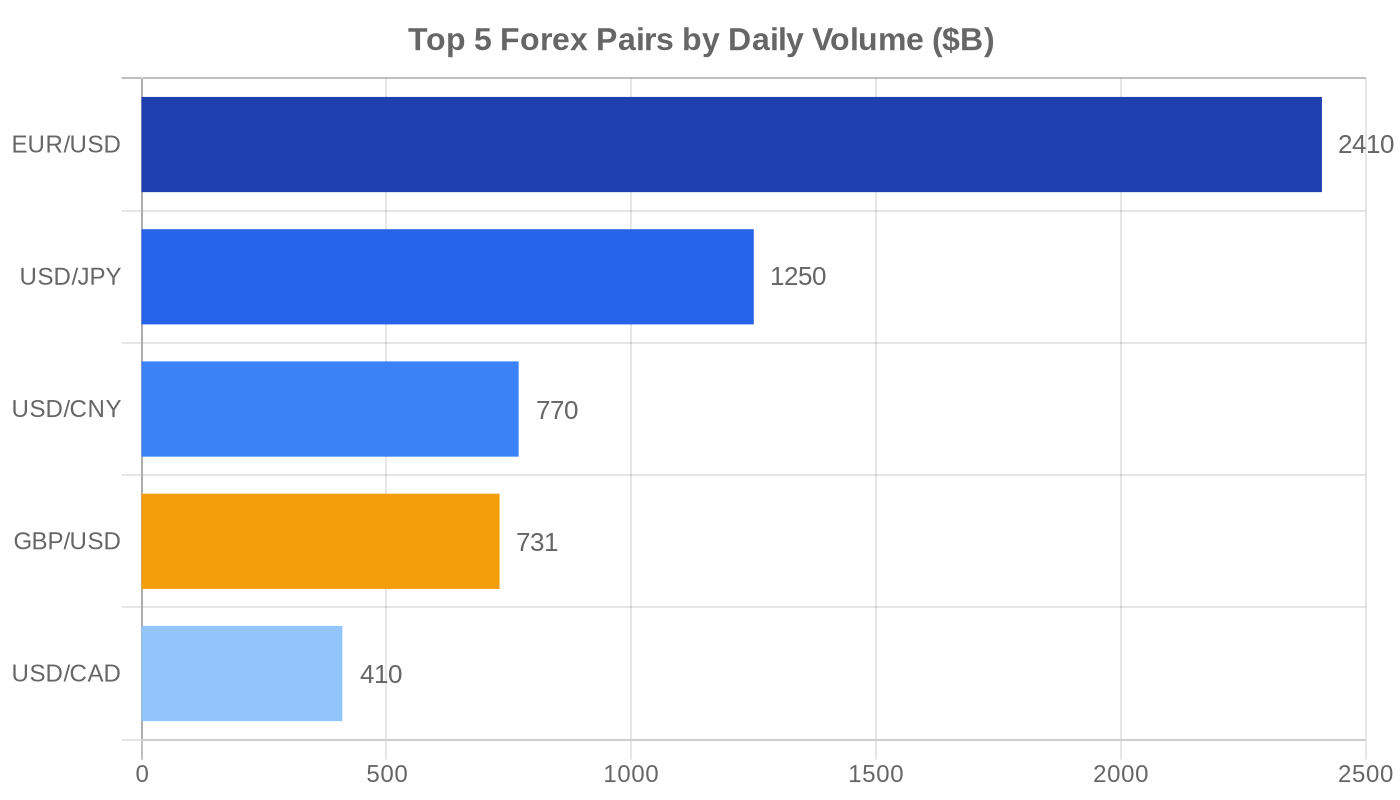
That $731 billion figure jumped from $714 billion in the previous 2022 survey. Spot trading in GBP/USD grew 19.5% over that period (BIS, 2025), suggesting retail and institutional interest in the pair hasn’t faded.
Why Is GBP/USD Called “Cable”?
The nickname dates back to 1866, when the first successful transatlantic telegraph cable connected London and New York. Before that cable, exchange rate quotes between the two financial centres could take weeks to arrive by ship. The telegraph cut that to minutes.
Traders started calling the GBP/USD rate “cable” because it literally travelled through a cable under the Atlantic. The name stuck. Over 150 years later, institutional desks and retail traders still say “cable is bid at 1.2650” instead of spelling out the full pair name.
It’s a bit of financial trivia, but knowing it signals fluency. When someone in a trading room says “long cable,” they mean long GBP/USD. If you hear “cable is falling,” the pound is weakening against the dollar.
How Does the GBP/USD Exchange Rate Work?
GBP/USD is a direct quote for anyone pricing in US dollars — the rate tells you how many dollars one pound buys. At a quote of 1.2650, you’d pay $1,265 for £1,000.
The quote has two sides. The bid is what a broker will pay you for pounds. The ask is what they’ll charge you to buy them. The gap between those two prices — the spread — is where brokers earn their margin. On GBP/USD, major brokers typically offer spreads between 0.5 and 1.5 pips.
A pip on GBP/USD equals 0.0001 — the fourth decimal place. If the rate moves from 1.2650 to 1.2660, that’s a 10-pip move. For a standard lot (100,000 units), each pip is worth roughly $10. For a mini lot (10,000), it’s about $1.
One thing worth flagging: GBP/USD quotes four decimal places, not five. Some brokers add a fifth digit (fractional pips), but the standard pip remains 0.0001. Don’t confuse a 0.00001 move on a five-decimal broker with an actual pip.
What Moves GBP/USD the Most?
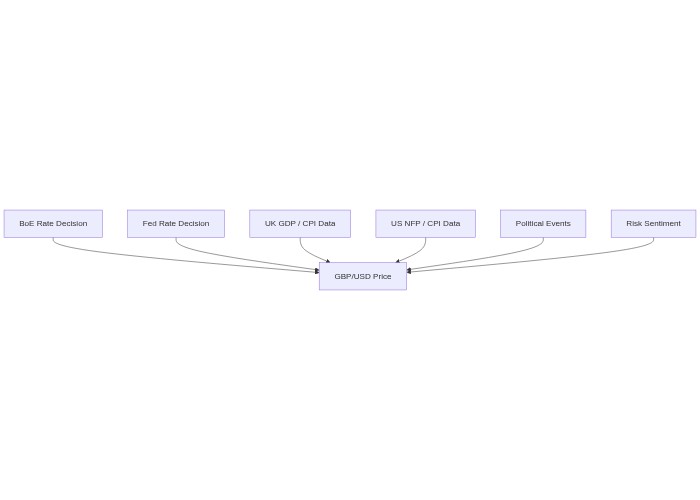
Interest rate differentials between the Bank of England and the Federal Reserve are the single biggest structural driver of GBP/USD. When the BoE raises rates while the Fed holds, the pound typically strengthens because higher yields attract capital inflows. That’s the theory. Reality is messier.
Economic Data Releases
UK releases that move GBP/USD: GDP growth, CPI inflation, employment figures, PMI surveys. The pattern is straightforward — stronger-than-expected data lifts the pound because markets price in a more hawkish BoE.
US releases that move the pair from the other side: non-farm payrolls (NFP), CPI, retail sales, ISM manufacturing. Strong US data lifts the dollar and pushes GBP/USD lower.
The biggest single-day moves tend to happen on NFP Fridays (first Friday of each month) and BoE rate decision days. If you’re holding GU through those events, expect widened spreads and fast price action.
Central Bank Decisions
The Bank of England sets UK monetary policy. Rate decisions land roughly every six weeks. Forward guidance — what the BoE signals about future moves — often matters more than the decision itself.
The Federal Reserve does the same for the dollar. FOMC meetings, the dot plot, and the Fed chair’s press conferences all feed directly into GBP/USD pricing.
When both banks are moving in opposite directions — BoE tightening while the Fed holds, or vice versa — GBP/USD tends to trend. When both are in sync, the pair often range-trades.
Political Events
Brexit proved that politics can dominate GBP/USD for years. The pound dropped from 1.50 to 1.20 in the aftermath of the 2016 referendum. That kind of structural repricing doesn’t come from data releases.
Today, UK fiscal policy announcements, trade negotiations, and general elections still move the pair. US midterms, debt ceiling standoffs, and geopolitical tensions affect the dollar side. Political risk on GBP/USD isn’t theoretical — it has a track record.
When Is the Best Time to Trade GBP/USD?
The London-New York session overlap — roughly 13:00 to 17:00 GMT — concentrates the highest GBP/USD trading volume of any four-hour window. Both financial centres are active simultaneously, and that overlap produces the tightest spreads and strongest directional moves.
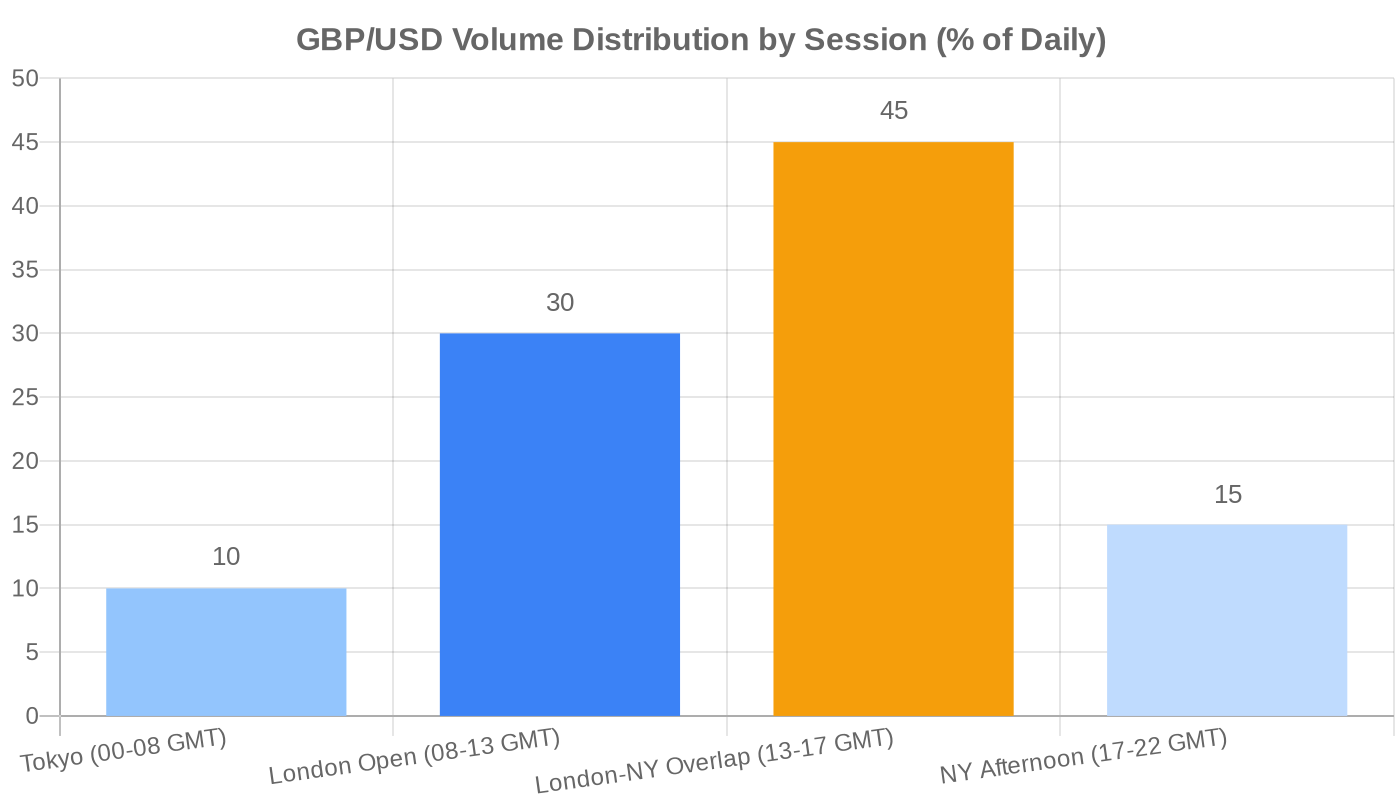
London opens at 08:00 GMT. GBP/USD usually wakes up here, as UK economic releases drop between 07:00 and 09:30. The pair often establishes its daily range during the London morning.
The New York session starts at 13:00 GMT. US data lands between 13:30 and 15:00 GMT, and the combination of US data hitting a market already active from London creates the day’s most volatile window.
After 17:00 GMT, volume drops. Spreads widen. The Asian session (00:00-08:00 GMT) is typically the quietest for GBP/USD — the pound and dollar aren’t home currencies in that timezone. Trading GU during Tokyo hours is possible but generally not ideal unless you’re working off a specific overnight catalyst.
How Volatile Is GBP/USD Compared to Other Pairs?
GBP/USD typically moves 80-120 pips per day on average, measured by the Average True Range (ATR). That places it firmly in the middle of the major pairs — more volatile than EUR/USD (which averages around 60-80 pips) but calmer than GBP/JPY, which can swing 120-180 pips daily.
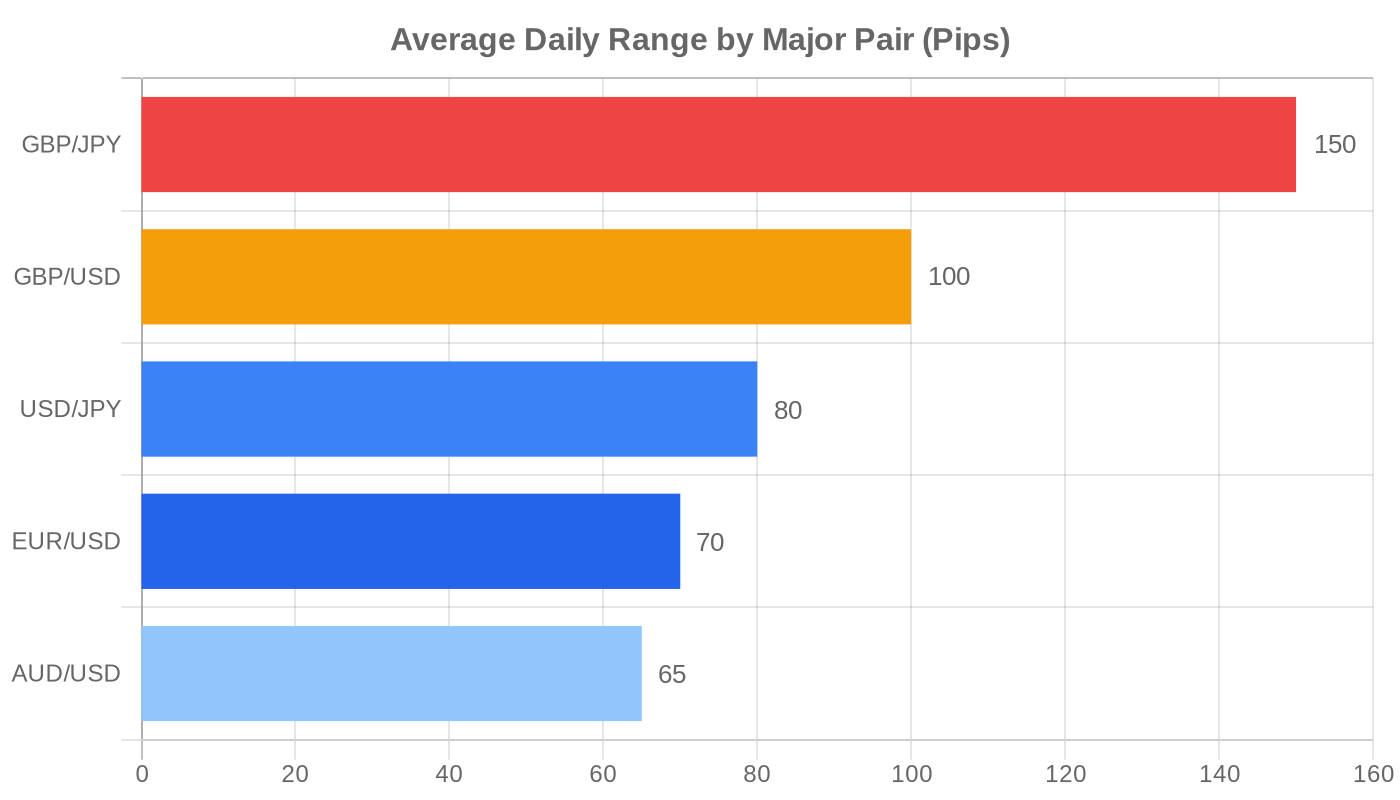
That volatility profile makes GU a solid middle-ground pair. Enough movement to generate trading opportunities over hours, not just days. But not so erratic that stop-losses get clipped by random noise every 15 minutes.
One important caveat: those are averages. On NFP day, after a surprise BoE decision, or during a political shock, GBP/USD can move 200+ pips in a session. The 2016 Brexit vote saw a 1,800-pip drop over months, and the 2022 UK mini-budget crisis pushed the pound below 1.04 intraday. Historical volatility spikes on this pair are well documented.
What Other Forex Pair Abbreviations Should You Know?
Forex traders abbreviate most major pairs by pulling the first letter from each currency code. GU is part of a broader shorthand system used across trading communities worldwide.
| Abbreviation | Currency Pair | Nickname |
|---|---|---|
| GU | GBP/USD | Cable |
| EU | EUR/USD | Fiber |
| GJ | GBP/JPY | Guppy |
| UJ | USD/JPY | Gopher |
| AU | AUD/USD | Aussie |
| UC | USD/CAD | Loonie |
| NU | NZD/USD | Kiwi |
| EG | EUR/GBP | Chunnel |
These abbreviations show up everywhere — signal services, Forex Factory threads, broker chat rooms, trading journals. If someone posts “long GJ, short EU,” they’re saying long GBP/JPY and short EUR/USD.
The nicknames are separate from the abbreviations. “Cable” predates electronic trading by a century. “Fiber” came later, reportedly because EUR/USD needed its own nickname once the euro launched in 1999 — and fibre-optic cables had replaced the old telegraph lines.
How Do You Start Trading the GU Pair?
Trading GBP/USD requires a forex broker account. The process itself isn’t complicated: open an account, verify identity, fund it, and select GBP/USD from the instrument list.
Choosing the right forex broker matters more than picking the pair. Look for tight GBP/USD spreads (under 1.5 pips on a standard account), regulation by a recognised authority (FCA, ASIC, CySEC), and a platform you’re comfortable navigating.
Before going live, consider a demo account. Every reputable broker offers one. Trading GBP/USD on a demo lets you see how the pair reacts to news events, how spreads behave during session overlaps, and how fast your orders fill — without risking capital.
Three practical notes for GBP/USD specifically:
- Position sizing matters. Standard lots on GBP/USD move $10 per pip. A 50-pip stop-loss means $500 risk. Size positions to risk no more than 1-2% of your account per trade.
- Watch the economic calendar. GBP/USD reacts sharply to UK and US data. Know what’s scheduled before you open a position.
- Correlation awareness. GBP/USD and EUR/USD often move in the same direction. Going long both is essentially doubling your dollar exposure — something worth checking if you’re managing multiple positions.
You can explore PipPenguin’s broker comparison tools to find a regulated broker that fits your trading style, and browse our forex trading guides for deeper coverage on strategies and risk management.
Risk disclaimer: Forex trading involves significant risk of loss. Between 74% and 89% of retail investor accounts lose money when trading CFDs, according to data published by FCA and ESMA-regulated brokers. Never trade with money you can’t afford to lose, and past performance does not guarantee future results.
FAQ
Is GBP/USD a good pair to trade for beginners?
GBP/USD works well for beginners because of its high liquidity — tight spreads mean lower entry costs. It’s one of the most widely covered pairs, so educational resources, analysis, and forex learning materials are abundant. That said, it’s volatile enough to punish poor risk management. Position sizing discipline is non-negotiable from day one.
What is the difference between GU and EU in forex?
GU refers to GBP/USD (pound vs dollar) while EU refers to EUR/USD (euro vs dollar). Both are major pairs with high liquidity, and both tend to move in similar directions since the dollar is the quote currency in each. EUR/USD has higher daily volume — roughly $2.4 trillion versus GBP/USD’s $731 billion (BIS, 2025) — and generally shows lower daily volatility.
What does “cable” mean in forex?
Cable is the market nickname for GBP/USD. It dates back to 1866, when the first successful transatlantic telegraph cable connected London and New York, allowing real-time transmission of pound-dollar exchange rates. Traders on institutional desks and in retail chat rooms still use the term daily — it’s one of those names that simply never went away.
What is the typical spread on GBP/USD?
Most regulated brokers offer GBP/USD spreads between 0.5 and 1.5 pips on standard accounts. ECN or raw spread accounts can quote tighter — sometimes 0.1 to 0.3 pips plus a per-lot commission. Spreads widen during low-liquidity hours (Asian session) and around major news releases like NFP and BoE rate decisions.
Is GU the same as cable?
Yes. GU and cable both refer to GBP/USD. “GU” is the two-letter abbreviation traders type in chat rooms and order tickets. “Cable” is the historical nickname from the transatlantic telegraph era. Same pair, two different labels used interchangeably.
About Author